Posts tagged: switch internet providers
Last Updated: November 1, 2026
Quick Summary
To compare internet providers by ZIP code, start with a broad search, then check availability at your exact street address, since coverage can differ between neighbors on the same street. Compare connection types, including fiber, cable, 5G home internet, fixed wireless, satellite, and DSL, along with total first-year cost, upload speed, and latency.
- A ZIP code can cover thousands of homes, so check your specific address.
- Confirm the service with the provider before scheduling installation.
- Build a first-year cost estimate that includes promotional and post-promotion rates.
- Upload speed and latency matter for video calls, backups, and gaming.
- Schedule new installation before canceling your current service to avoid downtime.
Table of Contents
- Why ZIP Code Alone Doesn’t Tell You What’s Available
- How to Check Internet Availability by Address
- Connection Types Compared: Fiber, Cable, 5G Home, Fixed Wireless, and Satellite
- How to Compare Internet Plans Beyond the Starting Price
- Switching Internet Providers Without Losing Service
- Get Your Address Checked and Compare Options Today
- Frequently Asked Questions
Why ZIP Code Alone Doesn’t Tell You What’s Available
Comparing internet providers by ZIP code is a useful starting point, but it rarely tells the full story. At MyNeighborhoodWiFi, we help customers compare internet providers by ZIP code and then narrow the list to what actually reaches their front door, whether you’re looking for Residential Internet, Business Internet & ADT Home Security, Check Availability & Get a Quote for your home or office.
Coverage can differ from one address to the next, so a provider that appears to serve your ZIP code may still be unavailable at your address. Checking the specific address is the most reliable way to confirm service.
How to Check Internet Availability by Address
Checking availability by address turns a broad search into a useful answer. For a step-by-step walkthrough, see our guide on confirming which internet services reach your home address.
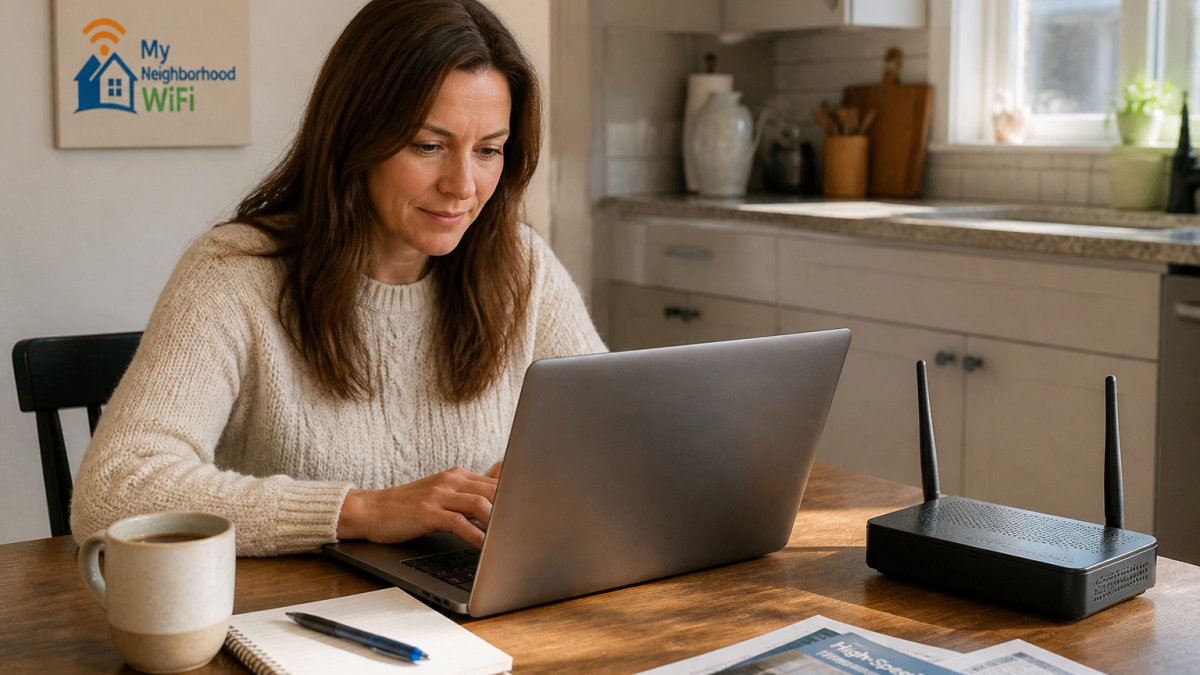
Using a provider’s address lookup tool
Many providers offer an address lookup on their websites. Use the exact street address, including unit number if you live in an apartment or condo. Note the connection types listed, such as fiber, cable, or 5G home internet, and write down the advertised download speeds and monthly prices. Repeat with two or three providers so you can compare on the same basis.
Confirming service before you schedule anything
An availability result is not a guarantee. Before you schedule installation, confirm service with the provider directly: ask whether the line to your address is active, whether any construction is needed, and whether installation fits your timeframe.
Connection Types Compared: Fiber, Cable, 5G Home, Fixed Wireless, and Satellite
Each connection type performs differently, and the right choice depends on how your household uses the internet, what infrastructure reaches your address, and which trade-offs you can live with. The table below summarizes how the main connection types typically differ.
| Connection type | Typical download range | Typical upload range | Latency profile | Common limitation |
|---|---|---|---|---|
| Fiber | High to very high | High to very high (often symmetrical) | Lowest | Limited footprint; not every address is wired |
| Cable | High | Moderate | Low to moderate | Shared neighborhood node; peak-hour slowdowns |
| 5G home internet | Moderate to high | Moderate | Low to moderate | Signal depends on tower proximity and home construction |
| Fixed wireless | Moderate | Low to moderate | Moderate | Line-of-sight to a tower or receiver |
| Satellite | Moderate | Low | Highest | Weather sensitivity; higher latency |
| DSL | Low to moderate | Low | Moderate | Distance from the central office; aging copper lines |
Ranges vary by provider and plan, so treat the table as a starting point and confirm the actual speeds offered at your address.
Fiber internet
Fiber uses pulses of light over glass strands and is generally known for symmetrical upload and download speeds, which can make it a strong choice for remote work and large file transfers. You can see what fiber internet service looks like in the Detroit market before deciding. The main limitation is footprint: fiber is not wired to every address, and availability can change block by block even within a single ZIP code.
Cable internet
Cable runs over the same coaxial lines that carry television service and is widely available in populated areas. Plans often advertise fast download speeds, but the neighborhood node is shared among subscribers, so speeds can dip during peak evening hours. Upload speeds are typically much lower than download speeds, which matters if you upload large files, host video calls, or back up to the cloud.
5G home internet
5G home internet uses a cellular signal to a receiver or gateway in your home rather than a wired line. It can be practical where wired infrastructure is limited, and installation is often self-service. Performance depends heavily on distance from the tower, walls between the gateway and the signal, and network congestion, so placement matters, moving the gateway near a window can change results.
Fixed wireless
Fixed wireless uses a directional radio link between your home and a provider’s tower or receiver, and it often requires line-of-sight, which trees, hills, and building materials can block. Upload speeds are often modest and latency is higher than fiber or cable.
Satellite internet
Satellite reaches the most remote locations because it does not depend on ground infrastructure near your home. The trade-off is latency: the signal travels to orbit and back, which is noticeable in video calls and online gaming. Weather can also affect performance, and many plans carry data allowances or priority thresholds. Treat satellite as a last resort when no wired or fixed wireless option reaches your address.
Check Availability & Get a Quote →
DSL internet
DSL runs over traditional copper phone lines. Speeds drop as distance from the provider’s central office increases, so two homes on the same street can qualify for very different plans. Availability of DSL can change over time, so confirm the service is still sold at your address before you commit.
If you need reliable upload speeds for video calls, cloud backups, or streaming your own content, fiber is often a strong option where it is available. If your address only qualifies for wireless or satellite, compare latency and data limits closely before you choose.
How to Compare Internet Plans Beyond the Starting Price
A low starting price can hide the real cost of a plan. Introductory rates typically have a set term, and the price afterward may change. To compare fairly, look at what you will pay across the full first year, including equipment rental, installation fees, and any taxes or surcharges.
First-year cost after promotional pricing
To compare plans on the same basis, build a first-year cost estimate for each option using this workflow:
- Promotional period. Multiply the promotional monthly rate by the number of months it applies (commonly 12, but confirm the term).
- Standard period. Multiply the post-promotion monthly rate by the remaining months in the first year.
- Recurring equipment fees. Add the monthly router, gateway, or modem rental fee for all 12 months, or note the one-time purchase price if you plan to use your own equipment.
- One-time charges. Add installation, activation, and shipping fees, and note whether the provider waives them under specific conditions.
- Taxes and surcharges. Add the taxes and regulatory or administrative fees that appear on the bill; these vary by location and plan.
- Contract and early-termination terms. Note whether the plan requires a contract and what the early-termination fee would be if you move or switch.
A plan that looks cheaper on day one may cost more over twelve months than a slightly higher but stable rate.
Upload speed, latency, data caps, and reliability
Download speed is only part of the picture. Upload speed matters for video meetings, file uploads, and online backups, and it is often the first thing to degrade on cable and wireless connections. Latency affects gaming and real-time calls; fiber and cable generally have the lowest latency, while satellite has the highest.
Some households that stream heavily or work from home may prefer plans without data caps.
Matching a plan to your household
Use the framework below to narrow the options before you compare prices. Treat the speed ranges as general guidance and confirm the actual tiers offered at your address.
| Household profile | Typical activities | What to prioritize |
|---|---|---|
| 1-2 people, light use | Browsing, email, HD streaming on one or two screens | A modest download tier; check the upload speed if anyone works remotely |
| 3-4 people, mixed use | HD and 4K streaming, video calls, gaming, schoolwork | A mid-tier download plan; low latency; a data allowance that fits peak usage |
| 4+ people or heavy remote work | Multiple 4K streams, large uploads, cloud backups, gaming | Higher upload speed (fiber preferred); no data cap; stable peak-hour performance |
| Smart-home or small business use | Cameras, connected devices, point-of-sale, VoIP | Upload reliability, low latency, and a plan that supports many simultaneous devices |
A few rules of thumb help translate the table into a decision. If you run a small business or want connected cameras and sensors, you can also look at ADT Home Security alongside your connection to see how the two fit together at your address.
A plan with a lower starting price may not be the best value once equipment fees, post-promotion rates, and performance limits are included. Compare total first-year cost, upload speed, latency, and data terms side by side before you choose.
Switching Internet Providers Without Losing Service
Switching providers can feel risky, but a planned transition keeps downtime to a minimum. Schedule the new installation before you cancel your current service, and confirm the new service is active before you disconnect the old one. Ask your new provider whether it offers help with the transfer, and find out what your current contract requires for early cancellation.
If you want flexibility without a long-term commitment, ask about no-contract options when you compare plans.
Get Your Address Checked and Compare Options Today
Comparing internet providers by ZIP code is a good first step, but checking your exact address is what confirms which plans you can actually get. Start with an address check, compare connection types and total first-year costs, and confirm service before you commit. When you are ready to see what is available where you live, visit https://myneighborhoodwifi.com or call 855-790-0031 to check availability and get connected.
Frequently Asked Questions
How do I compare internet providers by ZIP code?
Start by listing every provider that appears in a ZIP code search, then confirm each one at your exact street address, since coverage can change block by block. For each option, record the connection type, advertised download and upload speeds, the monthly price after any promotion ends, installation fees, equipment charges, and whether the plan requires a contract. Put these side by side in one table. Comparing the first-year total cost, not just the introductory rate, usually gives the clearest picture of which provider is the better value for your household.
Is ZIP code enough to check internet availability?
No. A ZIP code covers a wide area, and two homes on the same street can have different options because service depends on the wiring or wireless infrastructure reaching each specific address. Use an address-level availability checker from a provider or a comparison service to see what you can actually order. Treat a ZIP code search as a starting point for shortlisting providers, then verify at your address before you make a decision.
What should I check before switching internet providers?
Confirm that the new provider serves your exact address, review any early termination fees on your current contract, and ask about installation timing and whether equipment must be returned. Check whether the new plan’s promotional price changes after a set period and what the regular rate will be. Schedule the switch so you are not left without service, and keep your current account active until the new connection is working.

Quick Summary
The best way to find home internet providers is to check availability at your exact street address rather than relying on a ZIP code search. Address-level checking shows which providers actually reach your home, since lines and network upgrades vary block by block. Once you confirm options, compare connection types such as fiber, cable, DSL, and fixed wireless.
- A ZIP code can cover several neighborhoods, so it is only a starting point.
- Enter your full street address, including unit number, into an availability checker.
- Compare the true first-year cost, including equipment and installation fees.
- Size your plan to your busiest hour, not your average use.
- Check upload speed and typical evening performance, not just maximum download speed.
Table of Contents
- How Home Internet Providers Are Available at Your Address
- Internet Providers by Address: How to Verify Service
- Connection Types Compared: Fiber, Cable, DSL, and Fixed Wireless
- Internet Plans and Pricing: What the Monthly Rate Doesn’t Show
- Best Internet Speed for My Home: Matching Plans to Your Household
- How to Switch Internet Providers Without Losing Service
- Check Availability at Your Address and Compare Your Options Today
- Frequently Asked Questions
How Home Internet Providers Are Available at Your Address
Home internet providers in my area depend on one thing more than anything else: your exact street address. MyNeighborhoodWiFi helps customers compare home internet providers and check availability at their address, so you can see which options actually reach your home before you commit to a plan.
Many households assume that if a provider serves their town, it serves their street. That assumption often breaks down. Lines, network upgrades, and the type of connection built into a neighborhood vary block by block, which is why address-level checking matters.
Why ZIP Code Searches Can Mislead You
A ZIP code search is a useful starting point, but it is not a promise of service. A single ZIP code can cover several neighborhoods, apartment buildings, and rural stretches, and not every home inside it has the same options.
Searching by ZIP code can also show providers that cover part of the area while leaving your specific address out. Use a ZIP code search to build a shortlist, then confirm availability at your exact address before you compare pricing or schedule installation.
Internet Providers by Address: How to Verify Service
Verifying service at your address takes only a few minutes, and it saves hours of guesswork. Start by entering your full street address, including apartment or unit number, into an availability checker.
Once the results load, note which providers appear and which connection types they offer. Then compare the list against your household’s needs. A home with several streaming devices and remote work has different requirements than a single user who mostly browses.
Be aware that availability can change. New construction, network upgrades, and provider expansions all affect what is offered at a given address. Recheck before you sign if your search is more than a few weeks old.
Connection Types Compared: Fiber, Cable, DSL, and Fixed Wireless
Most home internet options fall into four connection types, and each one performs differently. Knowing the difference helps you read provider listings with confidence.
- Fiber: Uses fiber-optic cable to deliver the fastest and most consistent speeds, often with matching upload and download rates. It is available in fewer areas than cable.
- Cable: Runs over the same coaxial lines used for television. It is widely available and offers fast download speeds, though speeds can slow during peak evening hours.
- DSL: Uses existing copper phone lines. It is common in older buildings, but speeds drop with distance from the provider’s equipment.
- Fixed wireless: Delivers service through a radio connection to a receiver on your home. It can reach areas without wired infrastructure, but performance depends on line of sight and distance from the tower.
If fiber is available at your address, it is usually the strongest choice for households that upload large files or run video calls all day. If it is not, cable is often the next best option for speed.
Internet Plans and Pricing: What the Monthly Rate Doesn’t Show
The advertised monthly rate is only part of what you will pay, and the gap between the headline price and your actual bill is where most households get surprised. This section breaks down the line items so you can compare plans on a true first-year and ongoing basis.
The Cost Components Behind Every Internet Bill
When you compare plans, ask each provider to itemize the following. A plan that looks cheaper on the sticker can cost more once these are added:
- Introductory rate and its expiration date. Promotional pricing usually runs for a fixed term (commonly 12 months, sometimes 24). Ask the exact date the promotional rate ends and what the standard rate becomes afterward.
- Standard (regular) rate. This is what you pay after the promo. It is the number that matters for year two and beyond.
- Equipment charges. Modem and router rentals are frequently billed separately, and some providers charge for a combined gateway while others let you use your own equipment. Ask whether the rental is included, optional, or required, and whether using your own equipment is permitted.
- Installation and activation fees. Professional installation, activation, and self-install kit shipping can each appear as separate line items. Ask which are waivable and under what conditions.
- Taxes and regulatory fees. These vary by jurisdiction and are rarely included in advertised prices. Ask for an all-in estimate for your address.
- Contract term and early termination fee. Month-to-month plans cost more per month but carry no exit penalty; term contracts lock the rate but add a fee if you leave early. Ask for the exact early termination amount.
- Data caps and overage charges. Some plans meter usage or charge for unlimited data as an add-on. Confirm whether the plan is truly unlimited or capped.
How to Build a True First-Year Cost Comparison
Rather than comparing advertised monthly rates side by side, build a simple 12-month total for each provider:
- Multiply the introductory rate by the number of months it applies.
- Multiply the standard rate by the remaining months in the year.
- Add equipment rental for 12 months.
- Add one-time installation and activation fees.
- Add an estimate for taxes and regulatory fees.
That total, not the headline rate, is the fair basis for comparison. A plan advertising a lower monthly rate but charging equipment rental and installation can land higher than a plan with a slightly higher rate that bundles equipment.
Ask each provider for the “all-in” monthly amount including equipment and estimated taxes, and ask them to confirm it in writing before you order. This single request closes most of the gap between advertised and actual pricing.
Promotional Pricing Traps to Watch
A few patterns recur across providers and are worth flagging before you sign:
- Rate step-ups. Some plans increase the price in stages rather than once at the end of the promo. Ask for the full rate schedule.
- Bundle-dependent pricing. A low rate may require adding TV or phone service. Confirm the price if you take internet only.
- Auto-pay and paperless discounts. Some advertised rates assume enrollment in auto-pay and paperless billing; opting out can raise the monthly cost.
- Equipment that is “included” only during the promo. Confirm whether free equipment rental continues after the introductory period.
Contract Length and Flexibility
Contract structure matters as much as price. Month-to-month and no-contract plans cost more per month but let you leave without penalty, which suits renters or households that may move. Term contracts can lock a rate for a year or more but carry early termination fees if you cancel. Match the structure to how long you expect to stay at your address, and factor the early termination fee into your comparison if there is any chance you will move or switch.
Check Availability & Get a Quote →
Before you commit, confirm availability at your exact address and request a full cost breakdown from each provider on your shortlist. Pricing and fees change, so verify current terms directly rather than relying on an older quote.
The table below summarises the main cost items to check before you compare providers.
| Cost item | What to confirm | Note |
|---|---|---|
| Introductory rate | Exact expiration date | Usually 12 or 24 months |
| Standard rate | Price after the promo ends | The figure that matters in year two |
| Equipment charges | Rental, own equipment allowed | Modem and router may be billed separately |
| Installation and activation | Which fees are waivable | Can appear as separate line items |
| Taxes and regulatory fees | All-in estimate for your address | Rarely included in advertised prices |
| Early termination fee | Exact amount if you leave early | Applies to term contracts only |
| Data caps | Truly unlimited or capped | Some plans charge for unlimited as an add-on |
Best Internet Speed for My Home: Matching Plans to Your Household
The right speed depends on how your household uses the internet, not on the biggest number a provider advertises. This section gives you benchmarks for mapping speed tiers to real usage and flags the performance factors that advertised download speeds can hide.
Bandwidth Benchmarks by Activity
Use these general per-activity estimates to size your household’s peak load. For a ranked overview of providers, see top internet providers ranked for speed and reliability. They are planning guides, not guarantees, and actual needs vary by device and settings:
- General browsing and email: roughly 1-5 Mbps per active device.
- HD video streaming: roughly 5 Mbps per stream.
- 4K video streaming: roughly 25 Mbps per stream.
- Video calls (one-on-one): roughly 1-3 Mbps up and down; group calls can require more.
- Online gaming: modest download needs, but latency matters more than raw speed; plan for low latency rather than a high megabit number.
- Large file uploads and cloud backups: the more upload bandwidth the better; this is where fiber’s matched upload speeds help most.
Household Scenarios
Translate the benchmarks into a peak-hour estimate by adding up what runs at once:
- Single user, browsing and streaming: a modest tier is usually sufficient; do not overbuy.
- Couple, mixed streaming and remote work: add simultaneous video calls and streams, then leave headroom for background updates.
- Family with gamers, remote workers, and smart devices: peak-hour load climbs quickly; a mid-to-high tier with strong upload is the safer fit.
- Household with large uploads (content creators, cloud backups): prioritize upload speed, which fiber plans typically provide more consistently than cable.
Why Advertised Download Speed Is Not the Whole Story
Maximum advertised download speed tells you the ceiling, not the typical experience. Three factors matter just as much:
- Upload speed. Cable plans often advertise fast downloads but much slower uploads. If you run video calls, back up files, or work from home, upload is the number to check.
- Evening performance. Speeds can drop during peak evening hours on shared connections. Ask providers or neighbors about typical evening speeds rather than relying on the maximum.
- Latency. For gaming and video calls, low latency and stable connections matter more than raw throughput. A slightly slower plan with stable latency often feels better than a faster, jittery one.
Size your plan to your busiest hour, not your average use. Add up simultaneous streams, calls, and uploads, then choose a tier with some headroom, and check upload speed and typical evening performance, not just the advertised download maximum.
Matching Speed to Plan Tier
Once you have a peak-hour estimate, compare it against the tiers each provider offers at your address. Choose the tier that covers your peak load with headroom, and move up only if you notice slowdowns during normal use. Do not pay for speed you will never use, but do not undersize a household with several simultaneous users either.
Confirm which tiers are actually available at your exact address before comparing, since availability varies by neighborhood and connection type.
How to Switch Internet Providers Without Losing Service
Switching providers is easier when you plan the handoff. Before you cancel your current service, confirm that the new provider is available at your address and that installation is scheduled.

A practical sequence looks like this:
- Verify availability at your address with the new provider. Switch internet providers the easy way walks through the full process.
- Compare the first-year cost, including installation and equipment.
- Schedule the new installation for a date close to your current contract end.
- Keep your old service active until the new connection works.
- Cancel the old service once you confirm the new one is running.
Check your current contract for an early termination fee before you give notice. Knowing that cost in advance helps you decide the right timing.
Check Availability at Your Address and Compare Your Options Today
Finding home internet providers in my area starts with your address, not a generic ZIP code search. To learn how to check internet service at your address, see our guide. Use MyNeighborhoodWiFi to check availability at your home, compare plans and connection types, and request a quote. Visit https://myneighborhoodwifi.com or call 855-790-0031 to get started.
Frequently Asked Questions
How do I find home internet providers in my area?
Enter your full street address or ZIP code into an availability checker to see which providers serve your home. ZIP code results are a starting point only, because service can differ from one street to the next. Address-level checks show the connection types actually available at your home, such as fiber, cable, DSL, or fixed wireless. Compare the listed plans side by side, then confirm the final price with the provider before ordering.
How can I check which internet providers are available at my address?
Use an address-based availability tool and enter your street address exactly as it appears on your mail. Results will list the providers and connection types that can reach your home. Availability can change with construction or network upgrades, so recheck if a provider earlier said service was unavailable. Confirm the result with the provider when you place your order.
What internet speed do I need for my household?
Speed needs depend on how many people use the connection at once and what they do online. Light browsing and email can run on lower speeds, while streaming in HD, video calls, and online gaming benefit from higher download and upload speeds. Households with several heavy users, or people working from home, often choose faster plans. Compare the advertised download and upload speeds on each plan rather than relying on a single number.
Last Updated: October 26, 2026
Quick Summary
Internet providers near me can be found by entering your street address into an availability checker to see which providers serve your location, since availability varies by address even within the same neighborhood. Once you know what’s available, compare plans by download speed and contract terms to match your household’s needs.
- Check internet availability by address first, since providers may not serve all locations in your area
- Basic web browsing needs 3-5 Mbps, video streaming requires 25 Mbps, and multiple users benefit from 100+ Mbps
- Compare plans by download speed, upload speed, contract length, and equipment fees before choosing
- Download speed matters most for streaming and file downloads; upload speed matters for video calls and cloud uploads
- Real-world speeds vary from advertised maximums, so consider your household’s actual usage patterns
Table of Contents
- How to Check Internet Availability by Address
- Compare Internet Plans for Your Household Needs
- Choosing the Best Internet Speed for My Home
- Frequently Asked Questions
How to Check Internet Availability by Address
Finding the right internet providers near me starts with checking what’s available at your address, since a provider may not serve your location even if it serves your neighborhood. Enter your street address into an availability checker to see which providers deliver to your home, since speed tiers vary by address.

Start by checking internet availability by address to see which options are available. Residential Internet, Business Internet & ADT Home Security, Check Availability & Get a Quote lets you check what’s available at your location and compare your options.
Compare Internet Plans for Your Household Needs
Once you know what’s available, compare plans by speed and contract terms. Identify your household’s primary uses, since streaming, video calls, gaming, and remote work demand different speeds.
FCC broadband guidance on minimum speeds suggests that basic web browsing and email work at 3-5 Mbps, video streaming requires 25 Mbps, and households with multiple simultaneous users benefit from 100+ Mbps.
When you compare internet plans for your household needs, look beyond advertised speed and check contract length.
Check Availability & Get a Quote →
| Factor | What It Means | Why It Matters |
|---|---|---|
| Download Speed (Mbps) | How fast data comes to your home | Affects streaming quality and gaming performance |
| Contract Term | Length of commitment (month-to-month or 24 months) | Impacts flexibility if you move or want to switch |
| Equipment Fee | Monthly cost to rent a router/modem | Adds to total monthly cost; some plans waive it |
Choosing the Best Internet Speed for My Home
The best internet speed for my home depends on household size and activity.
NIST guidelines on broadband performance documents how speed affects real-world performance. Download speed matters most for streaming and downloading files; upload speed matters for video calls, live streaming, and uploading files to cloud storage.
When choosing the best internet speed for my home, consider future needs. Real-world speeds vary from advertised maximums.
Finding internet providers near me doesn’t have to mean endless research. Check what’s available at your address, compare plans that serve your location, and choose a speed tier matching your household’s needs. Check availability and compare plans.
Frequently Asked Questions
How do I find internet providers available at my address?
Enter your address into an availability checker to see which internet providers service your location. Address-level checks help you compare available plans before ordering.
What should I compare when choosing between internet plans?
Compare download and upload speeds, monthly pricing, and contract terms. Consider your household usage: streaming and gaming require higher speeds, while browsing and email require less.
What is the best internet speed for my home?
Speed needs depend on household size and activities. Check your current connection to see what you’re using now, then compare against your provider’s advertised speeds.